Monday, July 25, 2016

THE FOOD

     
Necessitites - Passport, Adhesive For Any Unforeseen Dental Issues, My Little Brother
   I’ve been out of commission since the several weeks of our return from Italy.  I’ll explain in upcoming blogs why but for now as I snuggle down and get comfy, cozy at my desk, the memories of our hike along the Franciscan Trail are as clear as the water in Lake Tresamino, in the Province of Perugia.  Now, while it’s true, Nancy and I have each traveled rather extensively during our lifetimes; few trips had as great an impact as this one.  Everyday was an experience steeped in spirituality and reverence.  We climbed to elevations that gave us glimpses of nature so vibrant and moving, it was as though we were walking through an artist’s dream.  But it was all real.  And the food.  For someone who works in that great soup bowl known as the culinary arts, I have always replied in a sheepish manner and an awkward “no” when answering the question, “have you ever been to Italy?”   This was even more embarrassing considering Italian is my most favourite cuisine to cook and to eat.
     As you may have gleaned from previous blogs on our Food, Faith & Alzheimer’s site, Nancy and I did our homework and beefed up our workouts in preparation for this trip.  We showed up to our Saturday morning walks wearing hiking boots.  Our friends faces indicating perhaps the boots were a bit of over-kill considering we hike only 3 miles in a well groomed and manicured park.  We outfitted ourselves with everything from walking poles, to rain ponchos to mole skin pads.  We researched the history of Saint Francis of Assisi, The Poor Clares, and of course, I reviewed some of the wines, ingredients and dishes indigenous to Central Italy. 
     Now I have always known meatballs are not standard fare atop a plate of spaghetti in Italy; they’re usually a stand-alone food item (on the side).  I’ve also known typical Italians do not allow pasta to swim, certainly there are no near drownings in any kind of sauce, as we do in here in the U.S.  Nor did I know so much beef, pork, duck, sausage and bison (yes bison) were consumed in Italy, at lunch and dinner.  Both Nancy and I were aware of the fact that true Italian pizza is much lighter than the stuffed crusts, or 5-meats or better yet, the ever-popular hamburger and fries topped pizzas currently sweeping our nation.  But I didn’t know the crust would be thin and light yet not so crispy as make me feel as though I’m eating pizza on a matzo cracker. And Alfredo sauce?  Should Nancy and I had entered a restaurant in Italy and innocently ordered Pasta Alfredo, our server would’ve worn a puzzled look on his or her face.  A reply of “Who’s Alfredo? Or, “He does work here,” would have been politely uttered.   So, if we had a real hankering for Pasta Alfredo, and nothing else would suffice, we would’ve had to ask for “Pasta di Bianco.”  We have since learned, Pasta Alfredo is an American-Italian restaurant dish.  In Italy Pasta di Bianco is typically prepared at home and reserved for when a loved one needs to eat something simple and easy on the stomach.  
No Speecy, Spicy Meatballs here!
     We certainly didn’t know all the details of farming and food production practices in Italy. Most of my research confirmed Nancy and I wouldn’t have to worry about gluten free, GMO’s or other food additives.  They just don’t modify their crops, soil and produce the way we do here in America.  Upon learning that tidbit, Nancy grew as excited about The Food as I was.  Even better, while hiking through Spello, we learned about the engineering triumphs of the Romans regarding the building of the many aquifers that to this day, bring the Italians and their visitors the crispest, clear and clean tasting water ever!  We were surprised to discover it was the Etruscans who taught the Romans many of the engineering feats the Romans went on to improve and perfect.
    So it was, after a 20+ hour flight and the loss of an American day, Nancy and I finally arrived in Rome.  Following everyone’s advice and pulling on our own travel experiences, we knew giving in to fatigue and going to sleep was not allowed.  So we quickly dropped off our luggage at our hotel and took a cab into Vatican City.  It was packed!!  I felt as though we were standing in Times Square on a Saturday night after the shows let out. 
We found an opening!
The pushing, the shoving, we did our best to meander like the tourists we were beneath the hot Roman sun.  By now our fatigue was competing with our hunger.
       We stopped at the second restaurant we found.  Deciding to dine al fresco, sitting under the veranda we ordered our first meal in Italy.  The anticipation was palpable as we fanned ourselves with our menus.  My heart was pumping as I waited for my ravioli and Nancy her spaghetti.  I leisurely took a sip of my red wine and watched Nancy as she did the same.  We were in public so I couldn’t spit it out.  Nancy’s face scrunched into such a twist; if I didn’t know better I would’ve sworn she had just bitten into a rotting lemon.  We sent it back.  The second wine selection was only slightly better.  But we were soon distracted as lunch arrived.  I’ll put it this way, when you’ve been sitting in airports and economy seating for a day and a half and you’re dead tired, eyes so dry they feel like sandpaper and you’re trying to quiet a grumbling stomach, you’ll eat almost anything.  Which we did.  As we shuffled our back to the bus stop we saw many more restaurants and found where we should have eaten! Oh well, next time. 
The first of many slurps to come. 
     That lack luster meal is now a distant memory. Every pasta dish, cut of beef, braised bison, sweet pastry, rich deli meat, ripe cheese, GMO free vegetable and lustrous gelato from that day forward was a transformative experience in gastronomy.    The Region of Central Italy is known for its velvety olive oils, the “king of chesses,” Parmigiano-Reggiano and Mortadella, the deli meat I ate until I was saw stars in this Hog Heaven of cured and seasoned pork. 
     The following day we left Rome and Nancy I and embarked upon an epicurean adventure that rivaled  expectations.  Antipasto platters boasted riches in meats, cheeses and breads, olives and citrus fruits all served with wine, of course.  high end grocers or our Farmers Markets, yet all regularly available in every corner market in Italy.  And truffles!!  Yes! ~ Those beautiful, dark and shriveled, umami gems.  Truffles on pasta, truffles on pizza, truffles on Panini!!  We even participated in a truffle hunt with one of the biggest, strongest, most handsome, outdoorsy Italian men (and his dog), I have ever met!!  So much ,fun! 
I hold in my hand, an elusive gem - the black truffle
 Always wine, with lunch, then again at dinner.
I fell in love. Twice.

This is the village where I ate 3 slices of pizza!
And the pizza!  So light, so soft, and so tasty.  With only one or two toppings and just a smattering of sauce, if any.  My new preference is just a bit of olive oil.  The photo above is the village where I had 3 slices of pizza at lunch.  Nancy's eyes popped out of her head when she saw eat like that! 

This was the most impressive deli counter I've ever encountered!


And the Produce!  Heirloom tomatoes, beans, peppers and squash that looks as though they were on steroids! But of course, we know they are not.  We saw food wonders only found in our most high end or local farmers markets.  I was drooling up and down every aisle of this particular market.  

One of our delightful meals in the medieval village of Gubbio

     Coffee, tea, espresso?  For years I have been brewing my morning coffee in a French Press.  I took a break for a short while as my last husband preferred drip coffee.  When I’m not home brewing my own coffee, I enjoy going out for Starbucks and when in California, Peet’s.  But no Starbucks or Peet’s in Italy, at least that we saw!   The coffee, strong and hot, is as far from dirt-tasting, coffee flavored water I’ve had served to me from one of those drip pots.  Nancy and I did our best to adhere to Italian coffee etiquette by having our macchiato or lattes in the morning only and keeping to espresso in the afternoon.  One of the other things (now I have countless) I love about Italy, is everyone pretty much greets their day in the same way, a good, strong cup of coffee and a pastry!!  I absolutely love pastries in the morning.  Yes, yes, I know, a healthy breakfast sustains energy and jump starts my metabolism, but a sweet cinnamon roll, fruit tarts, or cheese croissant are my definition of how to best promise light and happiness to my day. 
Every day!

Yes, we hiked 5 to 10 miles every day and still came home 5 pounds heavier.  Obviously.  
     We consumed our meals in people’s homes, Masonic temple dining rooms, old wine cellars, caves beneath homes, sidewalk cafes, and once, even outside on the sidewalk!!  No standing over the kitchen sink or trash can while hurriedly eating a sandwich or slice of something.  It is true, in Italy, meals really do last anywhere from two to three hours!  A far cry from the hurry-up and go mentality we subject ourselves to.  I recently found out school children here in Clark County School District are given 10 minutes to eat their lunch!  No wonder their table manners are, in general, lacking.  Who has time to chat and visit, let alone digest or even chew, when you have to be up and out of your dining chair in 10 minutes? 
An old and still active Monastery.  This room was once the wine cellar and now functions as the dining room.  
That is where I had the most incredible cannellini soup I’ve ever had!  Did I mention we had wine with every meal?  As for the meal themselves, lunch and dinner really are dining

     As an official outsider of the Clean Your Plate Club, I finally gained admittance on the evening we were served our final meal in Arezzo.  It was with great shock and surprise when Nancy witnessed my reaching for the robust bowl and serving spoon for a second helping of a tomato, red onion, cucumber and day-old bread concoction.  For it was here we were served my favourite Tuscan dish, Panzanella.  Hearty yet light, this industrious salad is ever so slightly dressed with olive oil and a drizzling of Modena Balsamic, and then topped with a few strands of basil.  This old peasant dish is a veritable garden of delightful colors, flavors, and textures, I absolutely loved it.  It is so simple to prepare and enjoyable to eat, here is my recipe for Panzanella.

Recipe for Panzanella


Ingredients

3 cups day old French bread cut into bite-sized cubes
¼ cup olive oil
salt/pepper to taste
1 tablespoons Italian seasoning or herbs de Provence
3 cloves fresh garlic – minced
Another ½ cup olive oil
½ cup good balsamic vinegar
1 small red onion – thinly sliced
1 1/2 cups each red and yellow cherry tomatoes – halved
1 English (Hothouse) cucumber - peeled and medium diced
7-10 leaves fresh basil – chiffonade

Process:

1)    Arrange bread cubes in a single layer, onto a parchment-lined sheet pan and drizzle lightly with olive oil. Sprinkle bread cubes evenly with Italian seasoning or herbs de Provence, salt and pepper.  Using your hands mix bread cubes to ensure all sides are coated with oil and seasoning
2)    Place in oven 350 degree, pre-heated oven. Toasting bread until light golden brown, about 20 minutes.
3)    Meanwhile, in small mixing bowl, whisk together ½ olive oil, balsamic vinegar and 1 of the minced garlic cloves.  Season to taste with salt and pepper then set aside. 
4)    When bread is done and has been allowed to cool, place in large serving bowl
5)    Add halved tomatoes, diced cucumber, red onion slices, remaining 2 cloves minced garlic and 1/2 the basil leaves
6)    Gently stir in olive oil and vinegar mixture to coat.  You may not end up using all the olive oil and vinegar mixure.  Garnish with remaining half of basil. 

May be served cold or at room temperature

                                                                          Makes 8  4-ounce Serv

Sunday, May 8, 2016

From Loaves And Fishes to Vapors And Foams

    
 Most of you are familiar with the Biblical passage of Matthew 14:13-21, the one that tells the story of Jesus’ retreat to a distant and isolated area off the shores of the Sea of Galilee.  Though he went there seeking solace to mourn the beheading of his friend and mentor, John the Baptist, throngs of people followed him.  His reputation for healing the sick and ailing preceded him. 
     So it was, after a long day of prayers, blessings and laying of hands, Jesus, his disciples and the 5,000 followers, were, of course, hungry.  Out of genuine concern one of the disciples suggested, since it was getting late, perhaps it would be a good idea to send the people away so they could go home or into the village for something to eat.  “That is not necessary - you feed them,” replied Jesus.  This response was met with reactions like; “But Jesus, we don’t have that much,” (I’m paraphrasing) “Hey man, we have only five loaves of bread and two fish here!”  They continued to moan, “That’s barely enough for our own supper!” 
Jesus sighs, somewhat exasperated, and calmly directs his brethren to bring the sparsely filled basket to him. 
After casting his eyes to the Heavens, reciting a few prayers and bringing blessings upon the scant meal, Jesus divided the contents of the basket into twelve pieces and told his followers to continue breaking the bread and distribute it among the crowd, along with the fish.  Still somewhat leery, but trusting Jesus, the disciples did as they were told.  As they moved among the crowd, from person to person, the twelve were stunned to see there was indeed enough, actually more than enough.  For after dispersing the original five loaves of bread and two fish through the immense crowd and enjoying their own servings, everyone’s stomachs were filled to satisfaction, all 5,000 men, women, children and the disciples themselves.
     While I won’t go into the many lessons of the story, I would like to consider the dichotomy of it as compared to one of our current day Modernist Cuisines; Molecular Gastronomy.  If you are not already familiar, this type of cuisine offers sophisticated diners a blend of physics and chemistry on their plates, along with visual feats not commonly obtained with edible ingredients.  Not unlike the meal partaken by Jesus, his disciples and the swarming crowd, the servings are small yet evoke exhilaration and excitement.  It’s true, good ingredients can do jitterbugs, jives and cha chas in your mouth, and when the dance is over, we are joyful and satisfied. 
     Akin to what Jesus did that wondrous evening, chefs are pushing the food envelope (or basket) by applying the mystery of science to food in such a way they succeed in springing surprise and delight to our palates by way of transparent ravioli, clear canapés or even air-laced essence of fruits and vegetables for their followers.  Though we usually view Jesus’ actions as miracles rather than science experiments, we can be no less impressed with this seemingly new fandangled approach to preparing and serving food. 
In its purest definition, Molecular Gastronomy is the science that studies the physical and chemical processes that occur while cooking.  I always get a kick out of asking my younger students how we can
change a liquid into solid.  The usual response is “by putting in the refrigerator or freezer” – water to ice.  Then I ask; “and to change a solid into a liquid?”  That answer comes as,” over fire or heat, to melt it down.”
  “So then,” I continue with a raised eyebrow, “ how is it that liquid cake batter comes together as an edible solid when we’ve subjected it the heat of an oven for 25-35 minutes? Certainly none of you have baked a cake in the freezer, right?”  Silence.
     Requiring a balance of the left and right sides of the brain, chefs who embrace this style of food preparation employ the science of a laboratory with the art of culinary concoctions in the kitchen.  In the case of Jesus and the 5,000, the fish was likely caught in the nearby sea and the flat bread hand-kneaded and pounded then baked by, well . . . anyone in the crowd.  No fancy names or dollar signs were assigned to the meal they shared that evening on the shore of the Sea of Galilee.  As for today’s Modernist Cuisine, likely there will be more than a few dollar signs on your menu.  And while your meal may start out with a line dropped into the ocean to catch the fish, that fillet will then be seasoned, cooked, pureed and shaped or manipulated.  From there who knows.  The chef may add some liquid nitrogen or use a whipping siphon to create a wispy, cloud-like sphere of halibut artfully framed with golden droplets of a mustard, thyme and caper sauce.  The sphere precariously set atop a miniature cake platter on a stark white plate with swirls of vapor encircling the masterpiece.  When brought to your table, you wait and watch as the vapor fades and then . . . dig in. 
A lovely depiction of edible Vapor c/o Pinterest
     If you’ve ever taken one of my cooking classes, you know I love food history.  (I’d like to mention the fact that “set” foams have been around since the 1700’s, in the form of meringues and mousses.)   I am forever intrigued by the changes and evolution our food takes in taste, form and function.  How far we’ve come from Chex Party Mix, Chicken a la King and Shrimp Cheese Balls.  Remember those green Jell-o molds?  Whenever I saw one in the refrigerator, which wasn’t often in my family, I would stand aghast at the suspended bits of fruit cocktail that ran throughout.  Now we have edible foam, vapors and essences, presented as entrees or side dishes built to vertical heights in near perilous arrangements which we eagerly dismantle.  On rare occasions I’ve stated something was actually too pretty to eat. 
Again, care of Pinterest - there are so many edible experiments out there for you to try!
     So just how long does the flavor of a good foam last on your tongue?  Only a moment, but with an honest appreciation of the artistry, your anticipation of the taste and wonderment of texture, when you finally spoon the airy concoction into your mouth, you realize that moment in time, though brief, was a worthwhile one.  If that particular epicurean experience wasn’t on your Bucket List, you'll add it as soon as you get home.  That dismay I felt as a child, standing in the gaping door of the refrigerator looking at Frankenstein-like Jell-o molds has given way to admiration and joy.  Especially when the flavors of a gelatinous rhombus of mango or icy garden peas assembled like a string of green pearls swirled in a Yin-Yang pattern around a comet of  compound butter leave the tines of my fork then bursts with an unexpected pop against my taste buds.  It’s magical. 
I can do Jell-O shots but still can't bring myself to eat this.
     Don’t get me wrong, there isn’t a chef among us who would balk at a simply and well prepared, freshly caught fish, served with a chunk of homemade bread dipped in olive oil, as Jesus and his followers did that day. 
      But the strides and creative experimentation associated with Molecular Gastronomy is mind blowing.  I refer you to Twist by Chef Pierre Gagnaire.  Located on the Las Vegas Strip, Chef has made a name for himself with creations such as Japanese Potato Foam, Gin Jell-O and Grape gelee.  Or é by Chef José Andrés.   This restaurant located in The Cosmopolitan serves its guests mercurial dishes such as Skate fish with Truffle Air (foam), their take on the empanada; a fois gras cotton candy gyoza.  A friend recently recommended I try the Beet Gazpacho.  Evidently, it’s not your average bowl of cold tomato and vegetable soup.  The menu items tend to be fluid, with the chefs taking into consideration seasonal foods and ingredients but one item you’ll not want to miss is their Sangria.  A “twist” on a cocktail in the form of those lovely, icy dipping dots, arranged in your glass in such a way, that you don’t eat it rather you savor each “sip” with a small tasting spoon.
     While Molecular Gastronomy cuisine tends to be light and served in small portions, many of the restaurants who brave the offering have multi-course meals, so you leave with a sense of immense satisfaction and perhaps some pride at your courage to try something so different and innovative.

Recipe for Salmon Mousse

Ingredients
16 ounces of smoked salmon or left-over cooked salmon    
*Additional smoked salmon pieces for wrapping/draping if desired    
16 ounces of cream cheese – softened                        1 teaspoon fresh dill + extra sprigs for garnish
juice and zest of 2-3 lemons                                        Salt and pepper to taste                                             1/8 teaspoon cayenne pepper                                      ¼ cup brandy
1-2 tablespoons heavy cream                                       1 small jar of salmon roe or other caviar

Preparation
Place cooked, chilled salmon into bowl of food processor.  Make sure there are NO pin bones or other inedible parts to your fish prior to putting it into mixing bowl.
Add cream cheese, 1 teaspoon of fresh dill, salt, pepper, juice and zest of 2 lemons, cayenne pepper, heavy cream and half of the brandy.  Blend ingredients together until a smooth paste is formed.  Taste to adjust seasoning to your liking.  If you need more salt, pepper, lemon or dill, add it.
If mousse is too thick add remaining brandy to thin slightly.  But remember, you want a consistency that can molded or spooned into individually shaped servings.Once mousse taste exactly how you want it, you may:

       A)Spoon into individual ramekins – then garnish with salmon roe, caviar and/or fresh dill
        B)Spread into a fish shaped mold that has been lined with plastic wrap for easy removal from mold
        C)Shaped into rounded mounds then wrapped with remaining smoked salmon pieces
        D)Spoon into a piping bag and pipe onto top of cucumber slices
           E) Spoon onto triangles of toasted bread 
Individual salmon mousse mounds draped with smoked salmon trimmings.

Thank you Sur La Table - my home away from home. 

A molded mousse.  Hello Happy-Weird looking Fish? 1955 called and they want their decorative accents back. 

Most simple of all - salmon mousse piped onto cucumber slices and garnished with caviar.  My favourite!!

*By the way Food Friends - I will be leaving for my Culinary Adventure to Italy this week.  Please follow me and Nancy as we walk along the Franciscan Trail raising awareness and hopefully money for Alzheimer's disease.  I'll be sharing more recipes and sharing our experiences.  Go to www.foodfaithalzheimers.blogspot.com.  You can help the cause by visiting our funding site at <http://j.mp/FFALZ>
Ciao!!


Monday, April 18, 2016

Four Months In and Where Are We?

     
So how about those New Year’s Resolutions?  Some of us prefer not to call them “resolutions” but rather “personal goals” or “fresh intentions.”  Whatever name you gave to them, if you made any at all, here we are four months in and . . . what? 

     I kicked my new year off with T.U.T.’s 30-Day Infinite Possibilities Project.  Yes, I journaled daily, which I pretty much do anyway, but during the challenge I wrote, contemplated and visualized a more purposeful and fulfilling life for myself and my family.  Setting specific intentions AND taking actions that would only aide in bringing me closer to living an authentic life, one with joy, financial serenity and that dream job.  Exactly how I was going to achieve my goals was a bit fuzzy, but the desired outcome was as clear as a perfectly prepared consommé.

     I noticed resolutions, intentions, or whatever, wasn’t really a topic of conversation for me and my closest of friends, Nancy, Suzy, and Karen.  I wondered, is that because we have reached an age where we know we’ll likely end up forgetting, watering down or giving up on those promises we made?  Why announce or whisper about things you’re planning to do to improve yourself or way of life, if you know from past experience, you’re not going to see them through anyway? 
I have something in my eye.  


     E-gads (there’s a 50’s term for you) if we all gave up on ourselves then there would be no self-help books, seminars, weekend retreats or talk shows on television!  But would you agree, unless there is especially unique going on or is beyond our control, I don’t believe humans inherently give up on themselves.  That would explain why there are, indeed, so many different types of diets and weight loss products out there.  Why there are so many therapists and psychologists gainfully employed, and why those retreats and seminars can charge a pretty penny.  We really want to do better, look better, write, speak, and live better. 
So I ask, you don’t have to answer, but I’d love to hear from you, how are you doing four months into 2016?  What do those numbers on the scale look like?  How are things at work?  Is your relationship going smoothly, getting along?  Still feeling the love?  Now, don’t stop reading!  I’m not trying to lay a guilt trip on you here (as we used to say in the 60’s).  I’m just wondering if anyone out there can initiate and sustain the desired changes or improvements in their lives based upon a promise made months ago.

     As for me, well, the numbers on the scale look okay.  While I’m working diligently to get that dream job doing what I believe I was put here to do, it’s still has not come to fruition.  But I haven’t stopped working towards my goal.  I’m still cooking healing foods, I’m still reaching out and talking to people who  might be able to help.  I’m out there hustling.


     My cookbook is finished!  Now that’s a big one.  I do have several proofs on hand but with the help of dear friends, we are making corrections and slight changes so the next printings are near perfect.  I promised myself more travel this year, and that’s happening next month, when Nancy and I make our way along the Franciscan Trail in Umbria Italy.  Relationship, partner?  Well I didn’t really prioritize that one, but it would be nice.  Not sure where I am on that one, I’ll just keep on truckin (1970’s)  Looks like I’m making my way through the slogans and sayings of the eras I’ve lived.  That one was for our beloved Tony Rodriguez.  See what or who catches my eye.   There are still 8 months left.
We miss you Tony!

     Looking back at those first days of 2016, according to my journal, many of my goals and intentions are quite do-able.  I’ve hit a few snags or been distracted by life, but I’m glad to say I’m still on track. I haven’t lost my way, completely.  I hope you haven’t given up on yourself, that you too are making your way towards your goals and aspirations. 
I hear you man, those snags can be distracting. 


     It’s true, life is a mercurial thing, but I wouldn’t have it any other way.  Otherwise we might as well live our lives like a metronome atop a beautiful piano, keeping time but never going anywhere.  Might as well  gag me with a spoon (1980’s) if that were to be the case.  So let’s not give up.  Get back on that horse, even if it is the 27th time!  Just get on wearing something different because none of us wants to adhere to that insanity of doing the same thing over and over again, expecting different results.  Maybe wear your hair differently or adorn yourself with a new pair of boots when you mount that horse.  We may have to readjust or tweak, but let’s not give up.  It’s just not in our nature. 

     Life is Good (oh gosh that’s an appliance logo; LG – didn’t mean to do that).  Let's admit it, life is all that and a bag of chips (1990’s) so let’s squeeze and pop open that bag.  Chips a-flying, who cares. 
And to help you, because you’re going to need lots of sustainable energy, I have just the thing.  A recipe, one with rolled oats, which are rich in fiber and lowering our blood sugar, strawberries with their instantly recognizable scent and bright red colouring, an alluring call to their vitamin B6, potassium and magnesium.  They have been referred as one of planets most healthy foods.  And rhubarb!  It is in season right now.  You will usually find these blushing celery-stalk-look-alikes displayed in your markets from April to June.  Related to the Buckwheat family, rhubarb is intensely tart but we can't ignore it vitamin A, and anti-oxidant packed value.  By partnering with ginger or in this weeks recipe, strawberries, we can tame the tartness and create something that tickles our palates with a kind of syrupy-tang.  Oh! and did I mention rhubarb is bears almost no calories and is naturally low in sodium and cholesterol?  Yes, making it an excellent diet food, if that weight thing is still on the new year's resolution shelf.  

  Can I call it a recipe for success?  Fo’ shizzle (2000’s c/o my bucket-list-celebrity-to-meet Snoop Dogg).

                                                   Rhubarb and Strawberry Muffins


Ingredients

1 cup rolled oats                      ½ cup sour cream               1 cup whole milk
1 cup all purpose flour            ½ teaspoon salt                   ½ teaspoon baking soda
1 teaspoon baking powder     1 teaspoon ground ginger    ¼ cup coconut oil
1 whole egg, beaten               ½ cup brown sugar              1 cup chopped strawberries
1 cup chopped rhubarb         2 tablespoons granulated sugar
Additional oats or sparkling sugar for garnish if desired

Process

In a small bowl, combine rolled oats, sour cream and milk.  Set aside until ready to use.


In a separate medium mixing bowl, whisk together flour, salt, baking soda, baking powder, and ground ginger.

In yet another small mixing bowl, combine coconut oil, egg, and brown sugar and set aside until ready to use.
 
I know this looks a bit gross, but it makes for a wonderfully moist muffin.
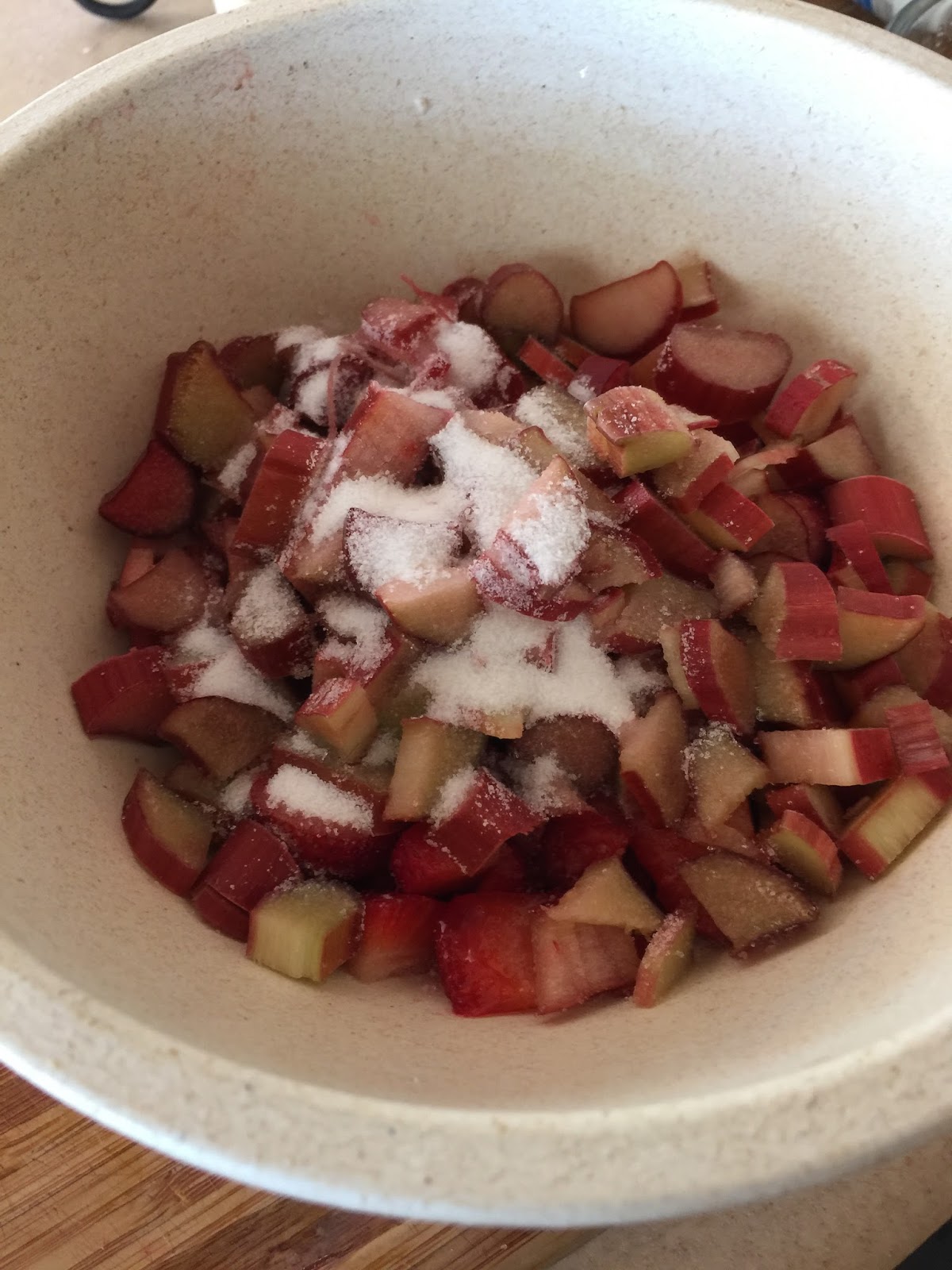
And finally, in the last small mixing bowl combine sliced strawberries, rhubarb and granulated sugar.  Allow the fruit to macerate while preparing other ingredients.


Stir oat mixture into oil and egg mixture.  Gently fold flour mixture in two batches into oat/egg mixture.  Mix just until flour is incorporated, do not over mix.  Allow batter to rest for 5-10 minutes.


When batter has rested, gently fold fruit into batter.  Spoon batter into paperlined cupcake pans.  If desired, sprinkle sugar or oats on the top of each muffin. 
Bake for 20-25 minutes, until muffins are golden brown.


                                                                                      Makes 18 - 20 standard sized muffins

These are so good!!  Light with just the right amount of sweetness, balanced with the magic of rhubarb.


Monday, April 4, 2016

Zzzzzz ~ Wake Up!! It's Here!!


Zander

Finally!!  It’s taken me 14 months to get through my Seasonal Alpha-Foods project, but we’re here, letter Zz.  So is there a food  currently in season that begins with Zz?  Hmmmm.
Of course I considered zucchini, but those are summer squash and we’re not quite there yet so obviously zucchini is not in season.  Ziti, is a favored Italian dish, but does not fall into the in-season food category.  Same goes for my beloved Zabaglione.  If you don’t know, a rich, yet light Italian custard involving a copper bowl, a whisk, egg yolks, sugar and usually Marsala. 
The best vessel in which to cook your Zabaglione - a copper pot.  
Those ingredients along with toned triceps and the endurance of an adolescent, male rabbit and his harem in springtime is all it takes to create this simple, almost ethereal dessert.
You may want to warm up before you pick up your whisk.  You'll be whipping up the custard for a while.
  Zebra Cakes?  No! Those commercially prepared cakes with black and white striped icing are lunchbox treats brought to us by  Little Debbie (Not to be confused with me, I’m big Deborah).  There are some out there, who are more intimate with the other Zebra Cakes with similar chocolate icing but display a white, squiggly line dancing across the center made by Hostess.  Oh, I forgot to mention that creamy filling inside, the best part, but unfortunately we can’t count Zebra Cake as an in-season food.  Year round, yes.  
I ate these regularly, with a diet Dr. Pepper during my dancing days. 
Zebra Cakes

I could make an argument for Zwieback, also known as rusk.  I had always thought Zwieback was the name of the company who made those crispy, rectangular biscuits, you know, like Kleenex and Saran Wrap.  But the retro-looking, yellow box containing the light, toasty, easily digestible crackers are indeed referred to Zwieback and are made by Nabisco.  Zwieback , in my opinion is the Scandinavian version of an Italian biscotti.  Both these biscuit-cookie-crackers are twice baked, but unlike biscotti, Zwieback are too light to dip into your cup of espresso.  They’re more like melba toast in weight and texture, but the small oblong shape is great for teething babies.  I gave them to my children as our Mother gave them to us when my brother, sister and I were young.  As we sat gnawing on our biscuits, she would spread a light coating of salted butter on a couple of them for herself and enjoyed them along with a cup of tea. 


Instead I came up with, Zander , which is in season at the moment .  Zander is a type of fish and is as easily prepared as any white, fleshy fish.  Zander is more commonly found on dinner tables throughout Britain than here in the U.S.  A white oily fresh water fish, that seems to do equally well in brackish waters, is much like our Walleye fish.  Zander or Pike Perch, as it’s also known, is a firm yet tender fish with few bones. It’s great in sushi or sashimi but I decided to share a simple pan seared version topped with a buttery, white wine and caper sauce.  This is perfect topped with a simple white wine pan sauce, a side of steamed or sautéed zucchini, and a small serving of Pearl couscous seasoned with maybe some fresh, chopped sage or lemon zest and fresh thyme. 


 Pan Seared Zander
You can substitute Walleye or even Halibut if you can't find Zander fish.
Ingredients
4,  4-6 ounce Zander fillets, pin bones removed                        salt and pepper to taste
2 tablespoon each, olive oil and unsalted butter                       2 additional tablespoons unsalted butter
4 tablespoons capers                                                             2 tablespoons fresh squeezed lemon juice
½  cup any dry white wine                                                     2 tablespoons fresh chopped parsley

Procedure
Season both sides of each fillet with salt and pepper.  You can leave the skin on if purchased that way and either eat it or remove it with a sharp, thin knife before serving.  We remove ours after cooking, then rough chop it and deep fry the pieces in hot oil.  Then we have some delicious cracklin’s to top our fish! 
In a large non-stick skillet, over medium heat, add olive oil and 2 tablespoons of the butter.  When oil and butter are shimmering and melted, add the fillet to the pan, skin side down first.  Don’t move the fish around in the pan, allow skin to become brown and crispy, about 3 minutes.  Gently turn fish to other side and sear another 2-3 minutes.  Remove fillets from pan, cover with tin foil, and allow to rest.
Meanwhile, reduce heat to medium low and add 1 of the remaining 2 tablespoons of butter to same skillet.  Use wooden spoon or a spatula to scrape off any tasty remnants from bottom of skillet, when you seared the fish.  When butter begins to smell slightly nutty, add lemon juice, capers and white wine.   Stir together on simmer, for about 2-3 minutes, then whisk in remaining tablespoon butter. 
Season sauce to taste with salt and pepper, then add fresh chopped parsley.  Plate Zander fillets on individual plates or one platter and pour pan sauce evenly over each.

                                                                                          Serves 4 
Don't forget a nice glass of white wine. Maybe some Zabaglione for dessert?

Monday, March 21, 2016

"Yy" Has It Taken Me So Long?

Beans with Blossoms
It’s long, slender and exhibits a brilliant shade of green.  I’m not referring to asparagus, though I  could be since it is currently in season, but asparagus doesn’t begin with letter Yy.  Hmmmm, you wonder, what exactly is in season that begins with letter Yy? Think, think, think.  I know they’re in your local markets now as they are pretty year round, Yams, with their Yy status are not truly in season until September.  Yogurt and Yeast begin with letter Yy, but can hardly be considered produce, no matter how much I try to stretch the concept.  And while Yakitori and Yachtworst are absolutely delicious, they constitute prepared dishes.  Think, think think . . . . Karen! you genius! ~ you’re right, it’s the Yard Long Bean, also known as the Chinese Long Bean or Snake Bean!!  These leggy legumes are commonly found in local Asian markets, and lucky for us are showing up in many Farmers Markets these days. 

A close relative to black-eyed peas, the Yarn Long is actually quite lovely as it extends down the vine to which it’s attached, growing up to 3 feet in length.  I was surprised to discover there are several more varieties than I've ever known: Red Seed, Black Seed, White Seed, the Stickless Wonder and the show-stopper of a looker the Purple Pod Yard Long. But the Southern Winner is purported to be among the most tasty of all.  A deeper shade of green than the other varieties, Southern Winner is a prolific producer resulting in crispy, sweet beans.  Many people may pick up a bunch of Yard Longs only to put them back down, thinking their soft, suppleness indicates age.  But Yard Longs tend to be less snappy than the traditional green bean.

Easy to grow, they produce flowers and pods in about 45 days.  Once they get going, should you decide to include them in your garden, you may find yourself going out almost daily to harvest.  As I mentioned earlier, they live up to their name Yard Long and each variety does indeed grow up to a yard in length, some even longer.  Displaying heart shaped leaves and small flowers, in white (as shown) pink or lavender in colouring, many people ascertain the flavor of a Yard Long is similar to that of asparagus.  Another common name for this bean I failed to mention is Asparagus Bean.  
A canopy of Yard Longs

Once harvested or purchased, Yard Longs will keep in your fridge for up to 5 days.  As for culinary uses, cook with them as you would any green bean.  Great in stir-fries, trimmed and cut on the bias they’re a beautiful addition to salads or as we use them frequently at Sur La Table Cooking School, in our Thai dishes.   

I prefer allowing them to maintain their elegant style by presenting Yard Longs whole, steamed and displayed on a platter, drizzled lightly with hazelnut infused oil, a generous sprinkling of fresh lemon zest and some crumbled goat cheese dancing across the arrangement!  Yum Yum for Yard Longs!

Oh! ~ I didn't answer the question as to "Yy" it has taken me so long to get back to my Blog.  That would be due to my finally completing my book, One 4-Ounce Serving, A Collection Of Food Stories And Recipes.  There will be an official book launch, hosted, hopefully, by Sur La Table at Downtown Summerlin in the next few weeks.  So watch this Blog or check out my FB page for the upcoming details.  Finally!!  Yahoo!  Yippee! (Yy words of excitement).
Yard Longs cut down to size - easier for eating I guess

Monday, February 15, 2016

Xing - Xang - Xong


It might look like gibberish . . .  because that’s what it is.  As we near the end of my Alpha-Foods series things are getting tougher!  To be honest, the ONLY food ingredient I could find starting with Xx is Xanthan gum.  That food additive produced from fermented corn sugar, commonly used as a thickener, emulsifier and/or stabilizer of many a commercially prepared food item found in your local grocery store.  I don’t intend on doing anything with that!  Actually, taking some culturalistic license I did find Xigua.  But xigua is simply another term for watermelon in some cultures.  And certainly not in season right now.  

I did find out, from a sommelier friend of mine, about the Xinomavro grape.  This little morsel was the primary grape used to produce red wine in ancient Macedonia.  He reports it was more of an elixir back then, but believes the grape is still used to produce wine in Greece today.  As much as I’d love doing the research and sharing with you a recipe to make wine, I hit a wall trying to locate where I could buy this edible berry.  So no wine recipe this week. 

Instead I am forced to consider Xacuti, Xavier Soup or Xampinyons.   Yes, these are actual dishes.  Since we’re no longer in the month of December, I can’t justify Xmas CookiesXampinyon is actually the Catalan word for mushroom.  I could write about the exciting array of mushrooms at our disposal.  Cépe, Chanterelle, Enoki, Morel, Puffball and Shitake to name just a few, so many more options than the early Greeks and Romans had at their disposal when they were cultivating mushrooms.  Rich, nutty and earthy, mushrooms are the example I often give when describing that 5th taste sensation, Umami.  My students are usually familiar with sweet, salty, sour and bitter, not so much the unctuous characteristics of mushrooms.  A piping hot , dripping with warm butter and stuffed to over-flowing with minced garlic and shallot, fresh parsley and grated Asiago cheese, of course the left over stems are chopped fine and incorporated into the filling with only a minute amount of seasoned bread crumbs, moistened with a fine Chardonnay. 

Perhaps introducing you to Xacuti, pronounced “sha-kooti,” would entice you.  This less familiar gem of a spicy chicken dish originated in Western India, Goa to be exact.  A bright red curry-like dish, often prepared with chicken, or goat or lamb and plenty of Kashmiri chilies hits those high notes and rings some bells.  Best served over rice and washed down with a cool beer.  I am tempted to try it.  A complex amalgamation of spices that include but isn’t  limited to, anise, coriander and fennel seeds, poppy seeds, cumin, cinnamon, turmeric, mace and nutmeg.  All cooked together in a large Dutch oven, with diced chicken and coconut.  Served over rice, this dish is calling me by name! 

Finally, there’s Xavier Suppe.  Now this consist of far fewer ingredients and also speaks to me, since it is Italian in origin, like me, and offers all the creature comforts of a healing soup.  So many of us here in Vegas are coping with or getting over severe head colds and the flu, so I deem this to be Soup Season.  Xavier Suppe gets its name from Saint Francis Xavier, who lived in Italy and was canonized in 1622.  The Feast Day of St. Xavier is held on December 3rd, and of course this soup is a component of the meal.  Easy to prepare, with few ingredients, all of which I have on hand; I’ve decided to use this recipe to express letter Xx.  There is very little variation in the recipes I researched, which I take to mean, it is as good today as it was in the 17th century. 

Well, except for the chicken stock.  The traditional preparation requires a rich chicken consommé which is actually homemade chicken stock, clarified.  I’m using commercially prepared, low sodium chicken stock. 
Pretty much all the ingredients you need right here. 


Ingredients

1 ½ cups all purpose flour                                ½ cup heavy cream
½ cup unsalted butter + 2 tablespoons             1-2 fresh leeks, cleaned and sliced
½ cup grated Parmesan or Asiago cheese + more for garnish
½ teaspoon each salt and pepper                     pinch freshly grated nutmeg
2 whole eggs plus 2 egg yolks                           6-8 cups chicken stock
2 tablespoons + additional for garnish, Italian parsley, chopped
2 tablespoons fresh chervil, chopped (you can substitute fresh tarragon if needed)
Be sure to peel back the layers as you rinse the leeks under running water. 

Sauteed leeks in butter.


Procedure

1       In a large heavy stock or soup pot, melt 2 tablespoon butter.  Add chopped leeks and cook until soft.  Add chicken stock and bring to a simmer.  Cover and keep warm over low heat. 
2      . In a separate large, heavy pot over low heat, stir together the flour, cream, butter, and grated cheese.  Continue stirring until mixture comes together into a soft but solid dough. 
Starting the dough for the dumplings.

Then is comes together so easily.

Piping out the dumplings using a Ziploc gallon bag.

3     3. Remove from heat and gently stir in salt, pepper, nutmeg, whole eggs, egg yolks and 2 tablespoons of the chopped parsley.
4       4.Spoon mixture into a piping bag (or large Ziploc bag if you don’t have a piping bag) fitted with a large tip.  If you’re using a large Ziploc, simply cut off a corner of the bag large enough to pipe out cylinder dumplings but not so big you end up with blobs squeezing out. 
5      5. Pipe 1” tube-like cylinders onto a sheet of waxed paper or buttered parchment paper. 
6       Allow dumplings to rest for approximately 30 minutes.
7       6.Meanwhile set another pot of salted water on the stove and bring to a gentle boil. 
8       7.When dumplings have rested, using a slotted spoon, gently lower 1/3 of the dumplings into the water and allow to simmer for 2-3 minutes or until they begin to float.  Mine are rather large, we like hearty dumplings in this household, so they didn't really float all the way to the top.  Use your slotted spoon to remove the cooked dumplings and gently slide into the pot of warm chicken broth.  Do this until all the dumplings are in the pot of chicken stock.

9       Immediately ladle Xavier’s soup into individual bowls and garnish each with the fresh chervil (or tarragon), parsley and cheese.
My dinner for the evening.

Kind of like an Italian "matzo ball soup" but even better!
                                                                    Serve with a warm baguette – Makes 6-8 servings

Note: However, I am planning on preparing that Xacuti.  It looks way too good to pass up the adventure.